
Clemmons Asphalt Plant: Where Things Stand Now That the Permit Is Public
|
A Tennessee paving company wants to build an asphalt plant off Gun Club Road. The county has now published a draft air permit, a public hearing is set for Dec. 1, and written comments close Dec. 3. Here is who actually decides, and how to be heard. |
Clemmons neighbors have spent months pushing back on a proposed asphalt plant off Gun Club Road. Until this week, there was no formal way to weigh in. That changed on Oct. 27, when Forsyth County published its draft air quality permit for the plant and opened the public comment period.
A draft permit is not an approval. The county has not decided anything. But it is the moment the public record gets made, and it comes with dates. Who wants to build it, and where?
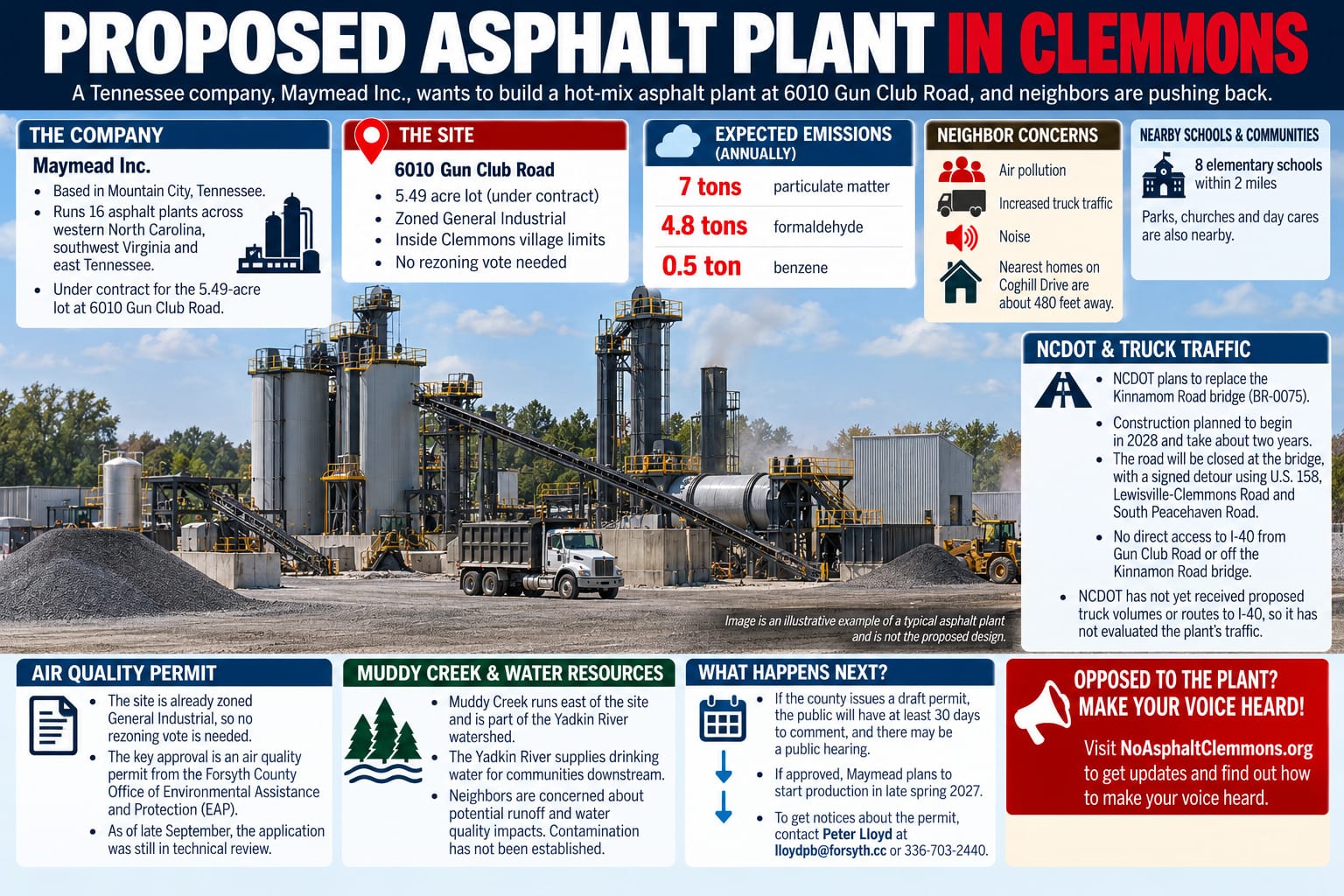
Maymead Inc., based in Mountain City, Tennessee, runs 16 asphalt plants across western North Carolina, southwest Virginia and east Tennessee. It is under contract for a 5.49 acre lot at 6010 Gun Club Road, in the Gun Club Industrial Park. The lot is zoned General Industrial and sits inside the Clemmons village limits. The nearest homes, on Coghill Drive, are about 480 feet away. Why there is no rezoning vote
This is the part most people get wrong, and both the Village and the county have taken blame for a decision neither one makes.
Asphalt plants are a permitted use in the General Industrial district. The land is already zoned for industry, so there is no rezoning request, and nothing for the Village Council or the county commissioners to approve or deny on land use. Clemmons' interim village attorney told the council as much during public comment in September.
The approval that matters is an air quality permit from the Forsyth County Office of Environmental Assistance and Protection. Forsyth runs one of only a handful of local air quality programs in North Carolina, which is why this is a county permit rather than a state one. What the draft permit would allow
The draft published Oct. 27 is permit number 01101. It would cap production at 325 tons of asphalt an hour, 2,500 tons a day and 300,000 tons a year. The equipment covered is a 75 MMBtu per hour drum mixer and dryer burning natural gas or fuel oil, controlled by a baghouse; two 200 ton storage silos; two truck loadouts; and a portable crusher, screen and conveyor for recycled asphalt pavement.
The permit is classified a synthetic minor source. That means the limits above are written specifically to hold the plant below the federal thresholds that would otherwise require a more stringent permit.
Those production figures are the first concrete numbers anyone has published about the plant's size. What neighbors are worried about
According to its application, the plant would emit about 7 tons of particulate matter, 4.8 tons of formaldehyde and half a ton of benzene each year. Neighbors are also worried about truck traffic and noise. Eight elementary schools are within 2 miles of the site, along with parks, churches and day cares. The site sits roughly 1,000 feet from Muddy Creek, a tributary of the Yadkin River. The Kinnamon Road Bridge
Truck traffic is a particular concern on Kinnamon Road, the narrow, curvy two lane road near the site.
NCDOT plans to replace the Kinnamon Road bridge, Bridge 0075, with bidding set for 2028 and about two years of construction. The road will be closed at the bridge during the work, with a signed detour using U.S. 158, Lewisville-Clemmons Road and South Peacehaven Road. NCDOT told ABC45 the plant would not change the bridge schedule and that the new bridge can handle additional trucks.
But NCDOT has not yet received truck volumes or proposed routes to I-40 from the project. So it has not evaluated the plant's traffic at all.
What Clemmons is doing instead?
The Village cannot stop the plant on zoning, but it can change what the zoning requires. On Oct. 26 the Village Council held a public hearing on a zoning text amendment, docket C-UDO-92, that would add conditions for asphalt and concrete plants in the General Industrial district. Right now there are none: the use is allowed by right, with nothing beyond the ordinance's baseline requirements. As proposed, a plant would need access from an arterial road or another route approved by the Village or NCDOT, a 100 foot setback from side and rear property lines for all buildings and operations, a 50 foot undisturbed buffer around the perimeter, and a six foot security fence with no barbed wire, razor wire or electrification. It would also require a 500 foot setback from any school, library or church lot, and from any property zoned residential, agricultural or commercial.
Village staff recommended approval, and the Planning Board recommended approval 7-0 at its Oct. 20 meeting. What the council did with it on Oct. 26 has not been published yet. An important limit: a text amendment changes the rules going forward. Whether it reaches this application, and whether the Gun Club Road parcel could satisfy a 500 foot setback, are separate questions. The infiltration story and the lawsuit
In September, Inside Climate News reporter Lisa Sorg reported that a man who helped organize the opposition as "Chris Sanderson" was actually Chris Hopkins, a consultant whose career has been spent at firms serving industrial clients, most recently Land Use Strategies. Hers remains the only source for that identification. Maymead has since sued Hopkins and the firm in Forsyth County Superior Court, alleging fraud, civil conspiracy and unfair and deceptive trade practices. The suit alleges he used the alias on behalf of an unnamed competitor to manufacture opposition where little existed. Maymead has not publicly identified that competitor and says it intends to name one during discovery. No court has ruled.
Hopkins denied in an interview before the suit was filed that "Sanderson" was an alias, and he has not responded to reporters since, so he has not given his side of the lawsuit itself. Land Use Strategies says he no longer works there and that the firm was not involved in the Clemmons project. Maymead's attorney said the company had never heard of him.
Local organizers say the opposition is stronger than ever. What happens next, and how to comment?
The comment period on the draft permit is open.
Public hearing: Tuesday, Dec. 1, from 5:30 to 7:30 p.m. at the Clemmons Public Library, 6365 James St. To speak, email your name and address to airpermittingnotification@forsyth.cc ahead of time. Speakers get three minutes each and are heard in the order they registered.
Written comments: due Wednesday, Dec. 3. Email aircomments@forsyth.cc, or mail the Forsyth County Office of Environmental Assistance and Protection, Forsyth County Government Center, 201 N. Chestnut St., Winston-Salem, NC 27101.
To read the draft: the permit and the county's statement of basis are posted on the Forsyth County air quality public notices page.
Questions about the draft permit: Minor Barnette, director, 336-703-2440. To get on the county's air permit notice list, contact Peter Lloyd at lloydpb@forsyth.cc.
A comment carries more weight when it is specific. Emissions, traffic volumes and routes, noise, hours of operation and proximity to schools are all within the scope of an air permit review; general opposition is harder for the county to act on. If the permit is approved, Maymead has said it expects to start production in late spring 2027.
👉 Opposed to the plant? Visit NoAsphaltClemmons.org to get updates and find out how to make your voice heard. (That site is run by the organized opposition, not a neutral source.) |
0 Comments
Join the conversation
Be the first to comment
Share your thoughts above.